
"MAM region"
200 article(s) found

Colombia Coffee Bean Flavor Description Grind Scale Variety Region Taste Introduction
The most famous of these is the Medellin of the Central Mountains, which has a heavy texture, rich aroma and a beautifully balanced acidity. Amania and Manizares are not so good, but these three kinds are considered to be the same type of beans in the market and are called "MAM". If you buy a bag of MAM, it means that the bag may contain any of these three beans, which have similar characteristics to Medeline.

How do you drink Colombian Medellin coffee? What are the characteristics of Colombian coffee beans?
Professional coffee knowledge exchange more coffee bean information please follow the coffee workshop (Wechat official account cafe_style) drink water to think of the source, drinking coffee should also know where it comes from! Most of the coffee beans in circulation on the market are distinguished by origin. Different regions, different climates, different soils, different coffee tree species, and different processing methods of raw coffee beans will make the taste of coffee beans different.

Colombia Coffee Producers Association-Coffee Flavor Description Treatment Quality Introduction
Colombia Coffee Producers Association-Coffee Flavor Description Quality Introduction Large commercial coffee farms are located in the central and northern regions, and are the main commercial bean producing areas, including the central region with a long history of Medlin, Armenia, Manizales (Medilin,Armenia,Manizales), commonly known as [MAM]. The fruit acid flavor is heavy and typical of Central America. but East

What is the uniqueness of Colombian coffee? Colombian coffee and its
The Colombian Coffee producers Association (Federacion Nacional de Cafeteos de Clolmbia), known as [FNC] for short in the industry, introduced the two main varieties of Colombian coffee, Kaddura and Colombia. Kaddura, which was introduced from Brazil in the 1960s, now accounts for 45-50% of the country's output and has replaced the earliest Tibica. A new breed with the same name as Colombia [Columby]

Colombia's two main coffee bean varieties Kadura and Colombia coffee bean production regional flavor
Colombia Coffee Producers Association (Federación Nacional de Cafeteos de Clolambia), or industry abbreviation [FNC] staff introduced the two main varieties of Colombian coffee, Cadura and Colombia. Kadura was introduced from Brazil in the 1960s and now accounts for 45-50% of Colombia's production, replacing the earliest Tibica. A new breed of the same name as Colombia [Colombi

Columbia Coffee producers Association-- introduction to the quality characteristics of Flavor description treatment
Colombian Coffee Bean in 1824, the Colombian and Peruvian coalition forces defeated the Spanish colonial army, and Peru gained independence. During the war with Bolivar's army in Peru, Santander took over as president and presided over the affairs of Colombia. Santander advocated the establishment of a federal regime and United local forces against Bolivar's political proposition of unity and unity. Within the Colombian Congress and government

A brief introduction to the market price of Colombian boutique coffee beans with mild taste
But Bucaramanca in the northeastern province of Santander is known for its low sour and bitter flavor, similar to Indonesia's Mantenin flavor, probably related to an altitude of only 960m (low altitude, low acidity, always good). Bucamanca's beans are very interesting, unlike the familiar Colombian flavor. Although they belong to soft beans, they are full-bodied and do not taste like [MAM] beans.

The History of Coffee: Colombian Coffee of good quality
For more information on coffee beans, follow the Coffee Workshop (official Wechat account cafe_style) in 1808, coffee was first introduced to Colombia by a priest from the French Antilles via Venezuela. Today, the country is the second largest producer after Brazil, with an annual output of 13 million bags of 60 kg each.
Columbia Coffee History, Climate, Environment, Coffee Flavor
Colombian coffee beans grow at high altitudes and are carefully cared for in the shade of banana and rubber trees. This kind of coffee is one of the best in the world. Rich, mellow, perfectly balanced. Colombia's arid mountains and well-drained, fertile volcanic soil provide ideal conditions for growing quality coffee. Coffee in Colombia is mainly grown in two regions, one

Coffee Country Profile: Colombia
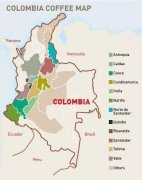
Picture 1: Traditional producing areas: Central MAM Eastern producing areas Common fine producing areas: Huila, Nario, Cauca In the 16th century, Jesus missionaries brought coffee to Colombia. In 1835, Colombia coffee first went abroad, exporting only 2000 bags. Colombia now exports millions of coffees. Although ranked highest in global coffee production,

Which is the best coffee in Colombia, Medellin Supremo or Jamaica Blue Mountain Coffee?
Three of Colombia's most outstanding coffees-Medellin, Armenia and Manisales-are all named after the regions where they are grown and are often sold together to simplify the transfer of large coffee contracts. The acronym for these coffee is MAM. Cauca currently covers an area of about 95000 hectares, with 93000

Colombia Fine Coffee Flavor Aroma Description
At present, most of Colombia's estates adopt the mixed planting model of 70% Kadura and 30% Colombia. Delicious Tibica has disappeared. Colombia's overall coffee variety allocation, roughly presented Kadura 50%, Colombia 30%, Tibica 20%. Colombia is rich in topography, low in latitude and high in altitude, and has excellent conditions for fine coffee growth. Costa Rica's coffee region lies between three and eight degrees north latitude, which is low

A brief introduction to the History and Culture of the Origin and Development of Colombian Coffee
Colombia is fortunate to have Atlantic and Pacific ports, which helps to reduce the cost of transporting coffee. In South America, she is the only country with this condition. The main production areas of Colombia are in the central and eastern mountains. The most important plantations along the central mountains are located in Medellin, Almenia and Manisales. In the above three areas
Recommended Colombia Coffee
Coffee was first introduced to Colombia in 1808 by a priest from the French Antilles via Venezuela. Today the country is the second largest producer after Brazil, with an annual production of 13 million bags of 60 kg each, compared to Brazil's 22 million bags. Coffee's place in Colombia can be seen in the following examples-all those entering the country

Colombia Coffee Plantation with Green Tea Flavor
Lumbia is rich in topography, low in latitude and high in altitude, and has excellent conditions for fine coffee growth. Costa Rica's coffee region is located between 3 and 8 degrees north latitude, belonging to the low latitude coffee belt, which can be harvested twice a year, and ripe coffee can be harvested almost every month from south to north. Large, entrepreneurial coffee farms are located in the central and northern regions and are the main commercial bean producing areas, including the historic plum in the central region.

Pure Colombia Coffee Flavor Introduction Fin Manor
German imports account for 25 per cent of Colombia's total exports, which also reflects the country's excellent quality. Coffee grades are divided into three grades: Supreme (Supremo), Excellent (Excelso) and Excellent (UGQ, Unusual Good Quality). Klauss coffee in the excellent grade is exported to Germany, and Europa coffee is exported to Nordic countries. Most coffee.

Flavor characteristics of Armenian Armenia Coffee in Colombian Coffee region Armenia Supremo
Professional coffee knowledge exchange more coffee bean information please follow coffee workshop (Wechat official account cafe_style) Colombia is the third highest coffee producing country in the world, after Brazil and Vietnam, plus Indonesia, ranking fourth, the total coffee production of the four countries accounts for 75% of the world, and the rest is mainly produced by Costa Rica, Honduras and Guatemala in Central America.

Colombia coffee-producing region Andes foothills
The coffee-producing region of the country is located in the foothills of the Andes, where the climate is mild and the air humid. Colombia has three Cordilleras (sub-mountain system) running north-south, right into the Andes. Coffee is grown along the highlands of these mountains. The terraces provide diversity in climate, which means harvest season throughout the year, with different species at different times.

Colombian coffee exports are mainly sold to that place.
Colombia is fortunate to have Atlantic and Pacific ports, which helps to reduce the cost of transporting coffee, which is the only country in South America. The main production areas of Colombia are in the central and eastern mountains. The most important plantations along the central mountains are located in Medellin, Armenia and Man.

Introduction to the varieties of Colombian coffee beans
In the early 1960s, coffee production was about 600kg per hectare. Now it has risen to about 900kg, and some farms can reach 2500 kg. However, quality assurance is a top priority for the coffee industry. Colombia established the National Coffee Management Association (Federacion Nacional de Cafeteros, or FNC) in 1927, which is responsible for quality supervision. Although the association is a private company